The problem
Content that airs or runs as advertising has to clear compliance: regulators and standards bodies like the FCC, Ofcom, and MPAA, and platform policies on YouTube and TikTok, depending on market and format. The review process is slow, manual, and hard to prove after the fact.
- Compliance review is done by people watching content against long rule sets, which is slow and inconsistent.
- Approval chains span multiple reviewers and stages, and tracking who signed off on what, and when, is painful.
- Separate compliance tools produce findings that never flow back into the asset, so the next team starts from scratch.
- Licensing and rights issues, like an unlicensed music track or a logo in frame with no clearance, surface late if at all, sometimes only after a platform rejects the content or a rights holder sends a legal notice.
- When an approval finishes, there is usually no clean record of what was decided and why.
Who it is for
- Broadcasters and advertisers that must clear content against regulatory standards.
- Compliance, legal, standards, and QC teams that own sign-off.
- Post houses and agencies managing client review and approval.
How Ceivo solves it
Ceivo runs compliance as an agent task over the understanding it already holds for each asset, checking against the rule sets that apply to your market and format. Findings are written back into the asset as time-coded metadata, so they are visible to every later reviewer and tool.
Review and approval is built in, with both parallel and sequential workflows. Multiple reviewers can sign off at once, or a sequence of stages can enforce order. Every step is tracked and auditable.
When an approval completes, an agent can summarize the entire workflow and generate a clean PDF artifact of the decision, the findings, and the sign-off trail. The record is automatic.
Because findings persist in the library, the same compliance understanding feeds the next workflow rather than being thrown away.
Compliance rules your legal team can write
Every framework Ceivo checks against, a platform's community guidelines, a broadcast standards code, or your own internal brand and legal policy, is defined in plain English, not code. Someone on the compliance or legal team writes what the rule is, what counts as a violation, and how severe it is, in ordinary language. There is no engineering ticket and no redeploy to add a rule or change one.
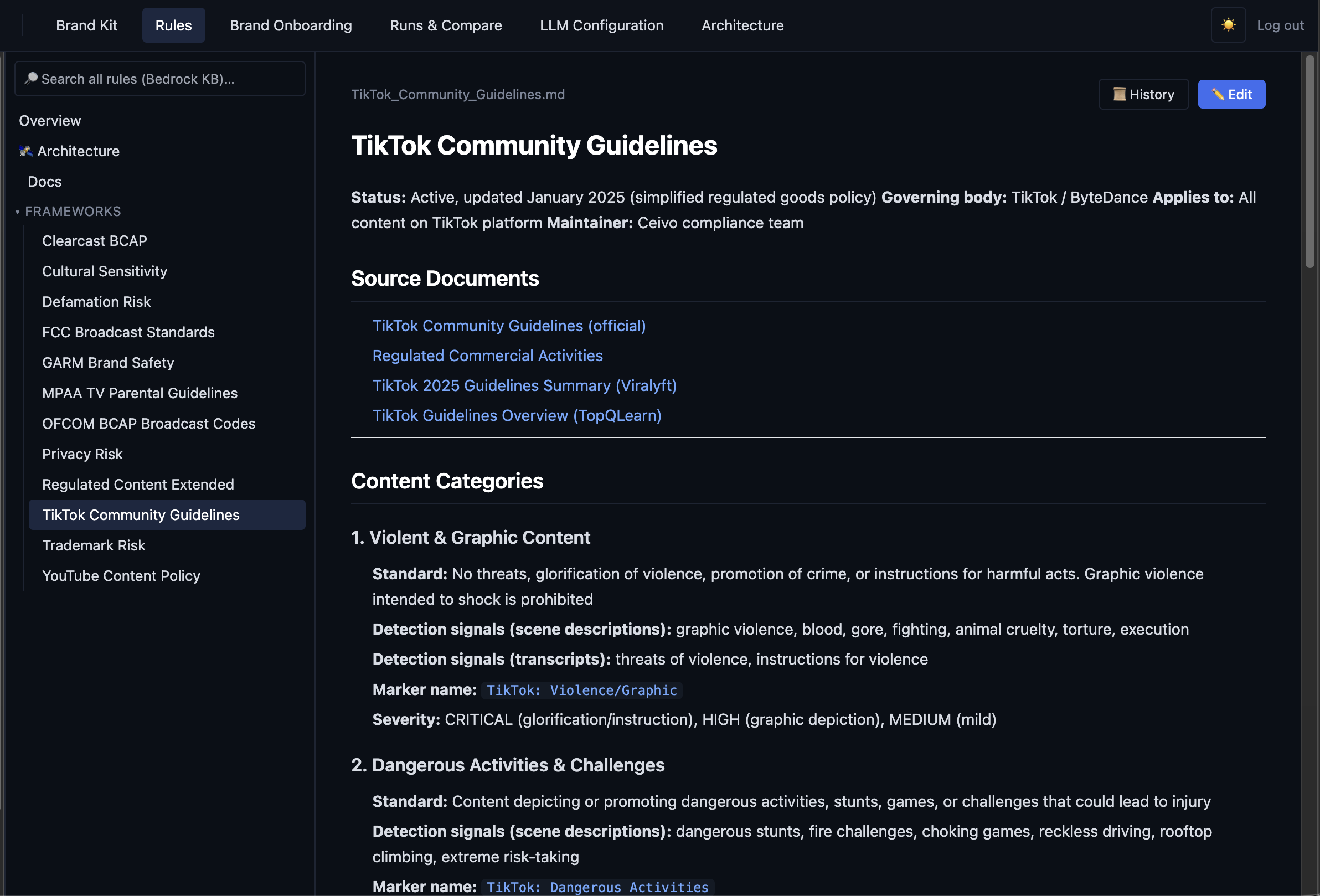
Ceivo's agents read those rules the way a compliance lawyer reads a script: they reason about intent and context, not just keyword matches. When a platform updates its policy, for example TikTok narrowing its guidelines on a regulated content category, your team edits the rule document and the change applies immediately across every asset the system reviews next.
Make legal the expert, not the screener
Ceivo watches for trademark, licensing, and rights risk at every phase of the media workflow, not just at final QC. Logos and branded products visible in a shot, needle-drop music with an identifiable rights holder, and named characters or other IP references are all detected as an asset moves from ingest through editorial to final export, flagged the moment they appear rather than discovered after the fact.
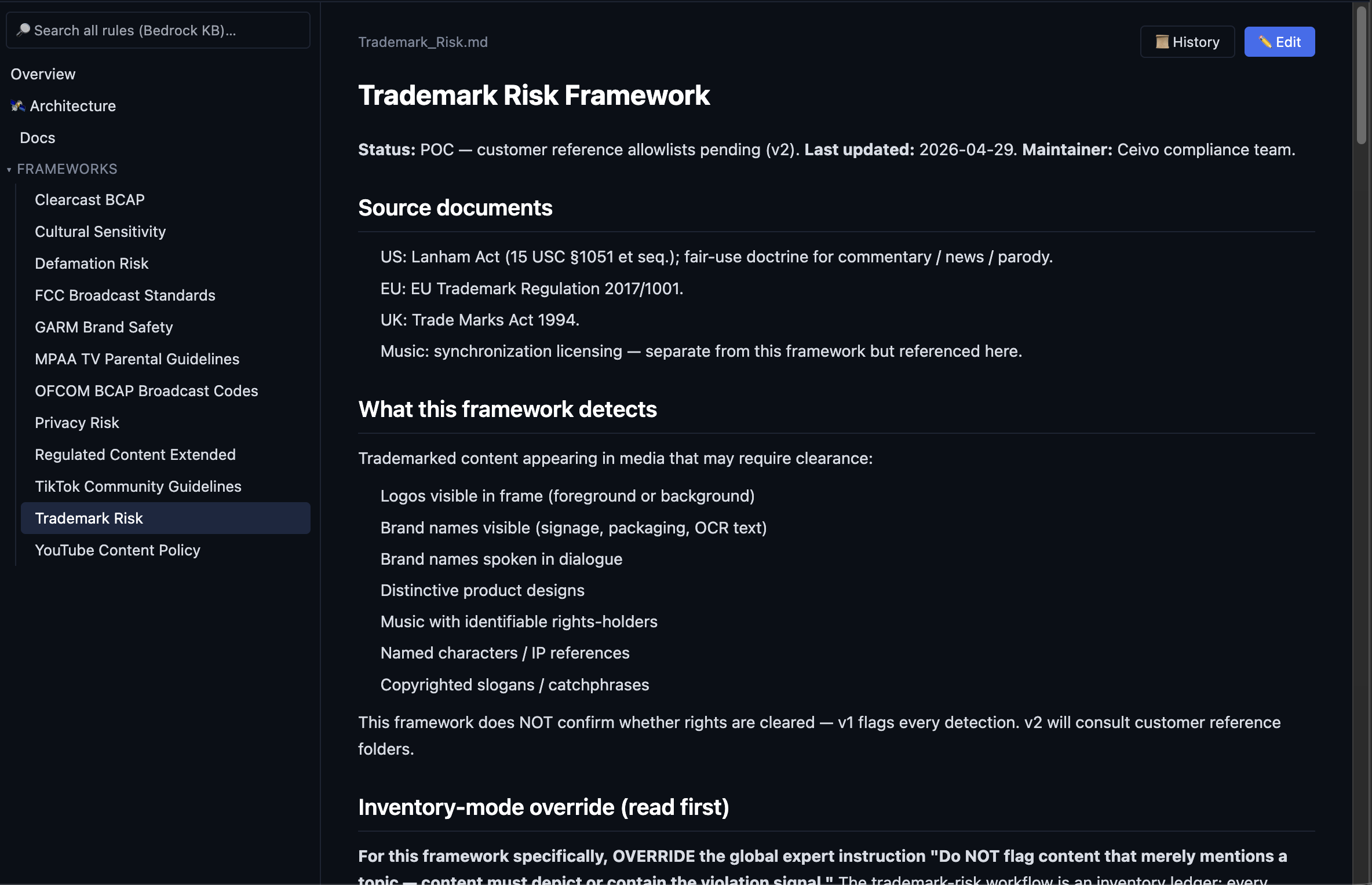
Review and approval still ends with a human. But instead of scrubbing an entire timeline, a reviewer opens exactly the issues Ceivo has already flagged, with the frame, the detection, and the reasoning attached. That is the point: strip out the noise so your legal team spends its time being the expert on the handful of calls that actually need one, not screening hours of clean footage. Ceivo does the watching. Legal stays the final gatekeeper.
In practice
An advertising compliance team needs to clear a spot before air. Ceivo runs a compliance pass against the relevant standards and surfaces issues pinned to time code. The spot moves through a parallel review where standards and legal sign off simultaneously, then a final sequential approval. When sign-off completes, an agent produces a PDF summarizing the findings and the approval chain, filed automatically against the asset. Nothing is re-keyed, and the audit trail is complete.
Or take a promo cut for TikTok. An editor drops a trending track into a thirty-second spot for energy, then exports. Ceivo's trademark and licensing scan catches the embedded music immediately: the track has no synchronization license cleared for social distribution. The issue is flagged, with the cue point and the rights holder attached, before the file ever reaches TikTok, not after a platform rejection and not after a cease-and-desist arrives from the label. The legal reviewer opens one flagged issue instead of the whole timeline, confirms the license path, and signs off.
Why Ceivo
- Compliance, review, and approval live in one system, on top of one understanding of the content.
- Parallel and sequential workflows with a full audit trail, plus an automatic decision artifact at the end.
- Findings persist and feed the next cycle, so the process gets faster and more consistent over time.
- Compliance rules are written in plain English by the people who own the standard, with no engineering required to add or change one.
- Trademark, licensing, and rights risk is caught at every phase of the workflow, with legal brought in only for issues that are actually validated.
Related
- Compliance at the speed of distribution: an agentic clearing workflow
- Brand Compliance and Safety
- Governed AI Access, the policy layer underneath review