Ceivo Atrium is a white-labeled portal where the people creating work in your brand's name (licensees, creative agencies, and localization vendors) submit creative for review, where Ceivo's AI agents pre-screen every submission before a human reviewer opens it, and where the reviewer's decision flows back to the partner the moment it is recorded. One branded surface replaces the email-and-shared-drive era of brand approval with a structured, audit-logged pipeline that scales to every partner relationship in your program.
For your partners
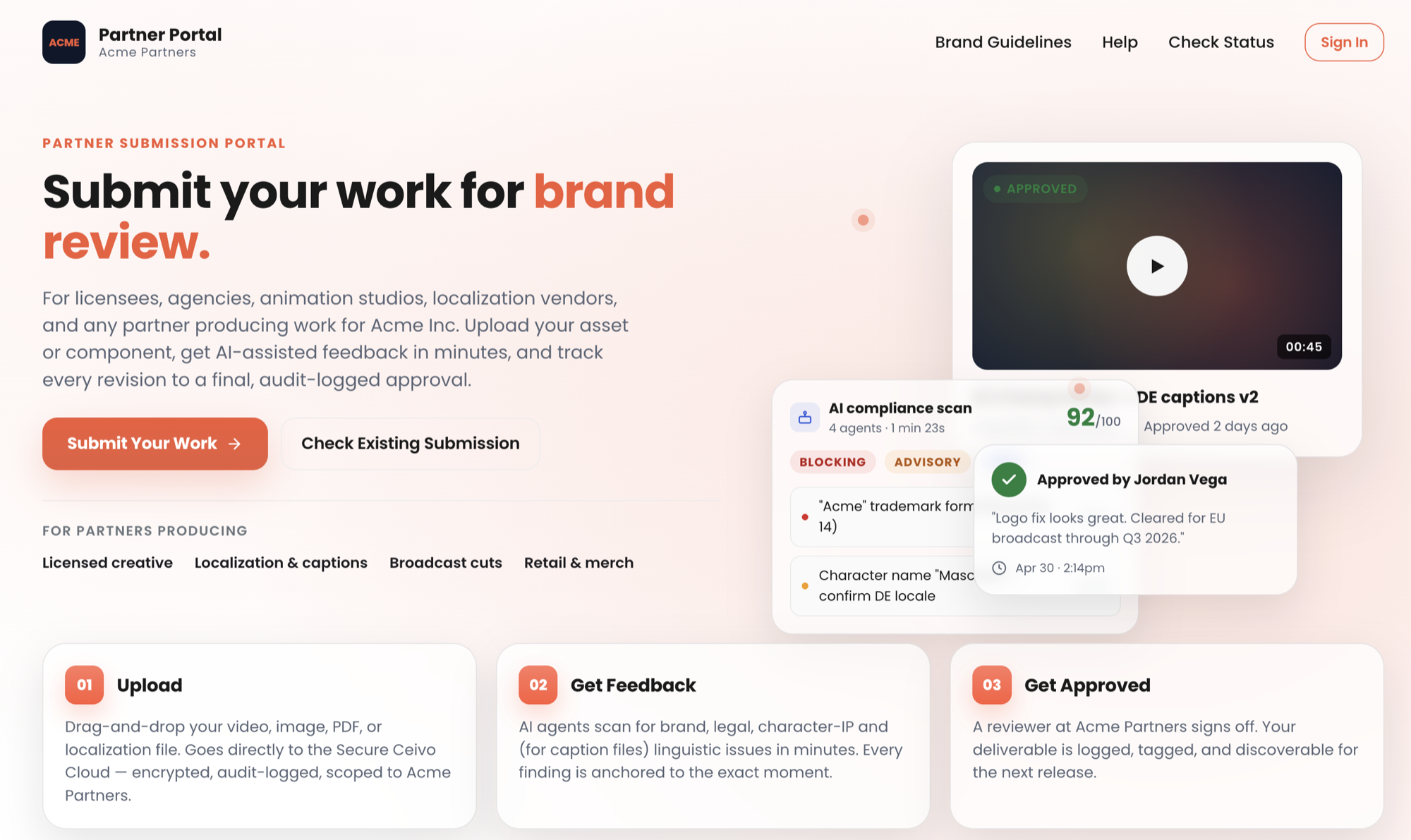
Atrium gives your partners a portal that looks like your product. Your logo, your colors, your typography, your subdomain, your hero copy. The submission flow lives inside the brand they are submitting work to, not inside a third-party tool.
Sign-on is either enterprise SSO against the partner organization's identity provider (so their InfoSec posture and MFA policy carry forward) or invite-only passwordless sign-on, gated by an organization-wide approval you control. The two models coexist inside the same portal so you can pick the right one for each partner.
Once a partner is in, the experience is one screen. Upload a video, an image, a caption file, or a full multi-file package. Tag it with the campaign, market, asset type, language, and any other field your team needs. Submit. Files stream directly into your Ceivo storage. The AI agents you have configured run in parallel, and the partner sees what was flagged, where in the asset, and why, before a reviewer ever sees it. Most partners fix the obvious problems themselves and resubmit a clean version the same day.
Conversations between partner and reviewer live on the submission. Comments are anchored to the version they were made against. Revisions stack under the original submission so the full history travels with the work. Status moves through clear states and updates the instant a reviewer records a decision. Partners never wait, refresh, or chase.
For your brand team
Inside Ceivo, your reviewers see every Atrium submission alongside the rest of the work they govern. Each submission lands pre-screened by the agent pass you configured for that upload type. A poster gets a brand-standards and key-art check. A localization caption package gets language validation and SDH style. A broadcast deliverable gets the full technical-QC pass. A social cutdown gets the lightweight version. Each upload type carries its own ordered agent fan-out, its own thresholds, and its own visibility settings, all editable in the admin console without involving engineering.
At the center of the experience is the Atrium Submissions Assistant, an AI agent whose only job is to write a one-screen brief for the human reviewer. It reads every finding from every agent that ran on the submission, de-duplicates across sources, and produces an overall verdict (PASS, REVIEW, or FAIL), a headline that names the most material item, a plain-prose narrative addressing each finding category, and stakeholder-routed callouts (Editorial, Legal, Brand, Music Clearance, Technical QC, Subtitles, Cultural Review). The brief posts directly into Ceivo's Review and Approval pane as a comment. Your reviewer reads the brief, opens the asset already framed by what the agents found, decides, and moves on.
Submissions in Atrium are not always single files. A campaign package can include the hero video, several cutdowns, a key art still, a localized lower-third, and a license document covering the music bed. A localization handoff is a full set of caption files plus a manifest. Atrium treats the package as the unit of review: one submission, one threaded conversation, one verdict, one audit trail, one decision the reviewer makes. The Submissions Assistant rolls findings across every file in the package into a single brief. "Poster passes brand standards. Soundtrack identified with timing. License covers the asserted use through 2027. Ready to approve." One reviewer, one brief, one decision.
Your admin team configures all of it from one console. Approve partner organizations, edit the email-domain allowlist, set the agent fan-out per upload type, define custom submission fields, toggle whether partners see raw AI findings or just the verdict, and wire up an outbound webhook so every status change posts into Slack, Microsoft Teams, Jira, or your internal dashboard. Every administrative change is audit-logged. (For background on why we believe the team that owns the work should own the agents that run on it, see the team that owns the agents owns the rules.)
Why this matters
Every brand owner who allows partners to make work in the brand's name has a partner-approval surface, and almost all of those surfaces are still email plus shared drives plus the patience of a brand manager. The cost is paid in reviewer hours, in rework when a finding goes missed, in slow turnaround that costs partners launch dates, and in the rare-but-expensive case of work that goes live without the right approval.
Atrium replaces that surface with one branded, AI-pre-screened pipeline that scales across every partner program your organization runs. Licensing, animation pickups, social and influencer programs, localization vendors in every territory, all run through one tool with one rule library, one audit trail, and one human in the loop on the decisions that need one. Your reviewers spend their time on judgement. Atrium does the assembly.
Private, contained, and InfoSec-friendly. Atrium runs in Ceivo's environment by default, or inside your own cloud account if your security team prefers it. Files stream directly into your Ceivo storage. Each portal is isolated from every other (no shared state between brands, no cross-tenant exposure), credentials are rotatable in place, every change is audit-logged, and you choose the sign-on model for each partner organization. Standing up a portal is a configuration change, not an engineering project.
Reach out to set up Atrium for your brand.